
ICYMI: Permitting Reform Takes Center Stage at Infrastructure Week Event
May 29, 2026
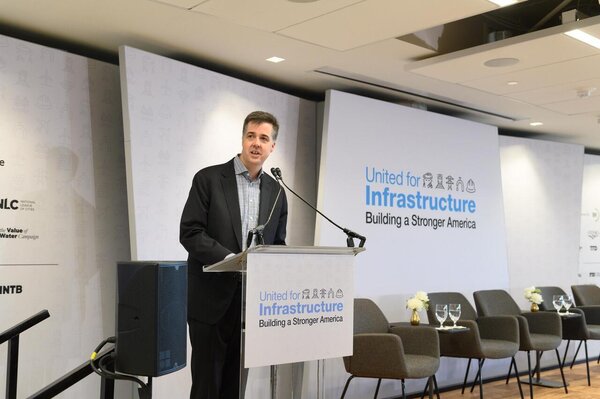
Photo: Business Roundtable Senior Vice President for Policy Matt Sonnesyn delivers remarks.
This year Infrastructure Week coincided with the bipartisan introduction of the BUILD America 250 Act, bringing renewed focus on the importance of infrastructure investment and permitting reforms to support U.S. competitiveness and economic growth. As part of the week’s programming, Business Roundtable hosted United for Infrastructure’s marquee event, “Building a Stronger America.”
The event convened leaders across government, business and labor to discuss how improvements to the federal permitting process can accelerate project delivery and unlock transportation investments nationwide. Here’s what they said:
On the cost of delays and the need for permitting certainty:
- Rep. Kristen McDonald Rivet (D-MI): “Hopefully, this notion of a bipartisan [permitting] movement here will really help in creating predictability, … long-term strategic priorities and plans that don’t shift from one Congress to the next, so that we can get these things built faster and with more predictability for our locals.”
- Rep. David Rouzer (R-NC): “Time is money. For every year of delay you have, it increases the cost of these projects [by] 20, 30 [or even] 40% if not more. … There’s significant investment like never before in bridges [and] bridge construction, which I think is very much needed, and really just [an] overall effort of trying to stretch taxpayer dollars, so we can get that much more done that much quicker.”
- Matt Sonnesyn, Senior Vice President for Policy, Business Roundtable: “One of the biggest barriers to progress is America’s slow and outdated permitting system. McKinsey & Company produced a report last year that showed that $1.5 trillion in investment is tied up just in federal permitting delays … and they estimate that’s holding back about $2.4 trillion in GDP impact from that investment.”
- Eileen Higgins, Mayor of Miami: “If an [infrastructure] project takes six years to start construction, the cost of that project is 40% higher than it was when I first estimated the cost of it. The cost … generally falls on the state and the local government to make up the match. … I'm very happy to see the commitment to faster timelines on all of the projects, because when I save money locally, … I’m able to save money for the people, either into their pocketbooks or onto a project that makes a difference in how they live safely in Miami.”
- David Gilford, Senior Advisor, Sidewalk Infrastructure Partners: “The average time for someone who is building a very large project, like a large data center, from the time at which they submit their first interconnection request to the facility being up and running is about seven years. … Every year, the speed of growth has been increasing, and honestly, it’s every month or so, when you look at the forecast that somewhere between $650 and $700 billion will be invested by just the top four computer users in the United States this year. That is a scale of private investment and private buildout that we just have not seen before.”
On the importance of permitting reform to strengthening U.S. competitiveness:
- Rob Gramlich, Founder and President, Grid Strategies: “China is building 80 times more grid capacity than we are. And to meet a lot of the same types of power demand, they’ve got advanced manufacturing, they’ve got data centers, they’ve got electrification. They’ve got all the same things over there, and those industries all seem to be saying, ‘Wow, China's just way ahead in terms of the grid capacity.’ … [W]ell, if we want to keep up and be relevant here, we need to get busy.”
- Samantha Smith, Strategic Advisor to the President for Clean Energy Jobs, AFL-CIO: “Permitting reform at the federal level would be a very good first step for us, if we’re going to do what so many other countries are doing. Our competitors, but also our allies, are electrifying their economies, and when we aren’t able to do the same, we are falling behind, in terms of our ability to export outside of the U.S. and to have globally competitive products and manufacturing in the U.S.”
Learn more about Business Roundtable’s permitting reform priorities here.
